Why an Independent Logistics Orchestrator Like Qonnected Is Essential for Contractors and Manufacturers

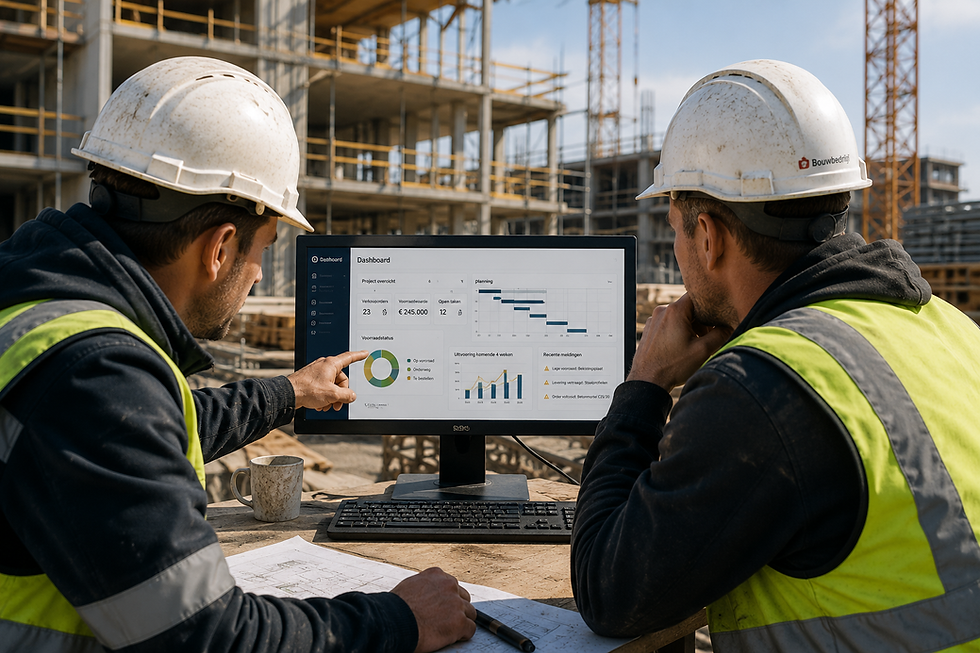
The construction and manufacturing industries are undergoing a fundamental transformation. Projects are becoming increasingly complex, margins are under pressure, sustainability requirements continue to rise, and supply chains are becoming less predictable. At the same time, contractors, manufacturers, suppliers, and transport providers often operate in separate systems with limited coordination. As a result, the need for an independent party that can connect, coordinate, and optimize the entire supply chain has never been greater. That is precisely the role Qonnected fulfills.
From Managing Logistics to Orchestrating Supply Chains
Traditionally, logistics has been viewed as the movement of materials from point A to point B. In today's construction and manufacturing environment, however, logistics encompasses far more than transportation. It involves synchronizing production schedules, inventory levels, transport capacity, construction planning, sustainability objectives, return flows, and real-time changes.
Qonnected does not position itself as a carrier, supplier, or contractor. Instead, it acts as an independent supply chain orchestrator. Through its AI-driven platform, Qonnected connects all stakeholders within a single ecosystem, specifically designed for the construction and building materials sector. The platform integrates with existing ERP and BIM systems while supporting future requirements related to circularity, ESG reporting, and zero-emission logistics.
Why Independence Matters
Many logistics solutions are offered by organizations that have a direct commercial interest in transportation, warehousing, or production. This often results in optimization efforts that benefit a single part of the supply chain rather than the supply chain as a whole.
An independent player like Qonnected focuses on overall supply chain performance.
This means:
No preference for specific carriers or suppliers.
Decisions driven by data rather than commercial interests.
Maximum transparency for all supply chain partners.
Optimization of total supply chain costs rather than isolated cost reductions.
Improved collaboration between organizations operating within the same market.
For contractors and manufacturers, this means logistics decisions are made based on what is best for the project and the broader supply chain—not for a single stakeholder.
AI as the Conductor of the Supply Chain
The true power of modern supply chains lies not in collecting more data, but in using that data intelligently. Supply chain orchestration is widely recognized as the next stage in the digital transformation of logistics networks. Artificial intelligence can predict risks, identify disruptions before they occur, and recommend alternative scenarios in real time.
Qonnected’s AI-powered platform functions as a digital control tower that continuously:
Monitors material availability.
Optimizes transportation flows.
Synchronizes deliveries with construction site schedules.
Tracks emissions and sustainability targets.
Predicts bottlenecks before they arise.
Calculates alternative scenarios when disruptions occur.
As a result, logistics evolves from a reactive process into a predictive and proactive capability.
Higher Profitability Through Reduced Waste
Many construction projects experience unnecessary waste caused by:
Deliveries arriving too early.
Deliveries arriving too late.
Empty transport miles.
Excessive storage requirements.
Duplicate transportation movements.
Poor communication between stakeholders.
Qonnected focuses on eliminating these inefficiencies. Better logistical alignment and stronger supply chain collaboration directly contribute to improved profitability for contractors, manufacturers, distributors, and project owners.
Where traditional logistics focuses on controlling costs, supply chain orchestration creates value by enabling the entire ecosystem to operate more intelligently and efficiently.
A Critical Step Toward Circular Construction
The future of construction is circular. Materials will no longer simply be delivered and consumed; they will be returned, reused, repurposed, and reintegrated into future projects.
This requires a fundamentally different logistics model. Materials must be traceable, return flows need to be coordinated, and information must be accessible to all relevant stakeholders. Effective circular supply chains depend on transparency, collaboration, and centralized coordination.
Because Qonnected is not tied to any single party within the supply chain, it is uniquely positioned to act as a neutral coordinator of these circular material flows.
The Construction Industry Needs a Conductor
Today’s construction supply chain increasingly resembles an orchestra. Manufacturers produce, suppliers distribute, transport providers move materials, and contractors execute projects. Yet without a conductor, the result is often misalignment, delays, and inefficiencies.
Qonnected serves as that conductor.
Through its independent position, AI-driven platform, and commitment to collaboration, Qonnected ensures that every participant in the supply chain moves in the same direction at the right time. The result is lower costs, greater reliability, improved sustainability, and ultimately stronger financial performance for all stakeholders involved.
Conclusion
For contractors and manufacturers, logistics is rapidly becoming a strategic differentiator. In a market where speed, sustainability, transparency, and collaboration determine success, an independent supply chain orchestrator is no longer a luxury—it is a necessity.
Qonnected demonstrates that the future of logistics is not about who moves the goods, but about who can orchestrate the entire supply chain most effectively. By combining artificial intelligence with complete independence, Qonnected enables a smarter, more resilient, and future-ready supply chain for the construction and manufacturing industries.
Calculate what your organization can save via this link
Sign up by planning a meeting with us through the following link


Comments