Your opportunity to tab into our client base AND improve your margins.
Dramatically...
history
The only reason for having a role in the supply chain is adding value.
If not, that role is cut out by online market transparancy.
The building materials industry still operates much as other industries did 40 years ago.
Suppliers continue to deliver directly to individual buyers, who are often wholesalers that then organise another round of transport themselves. On construction sites, trucks from different suppliers arrive one after another, frequently carrying small loads destined for multiple locations.
This fragmented approach leads to significant inefficiencies. On average, only 60% of a vehicle's loading capacity is utilised, while return trips are often made empty. The result is unnecessary cost, congestion, and environmental impact.
We are your best client ever...
We have the assignment of the largest builders to take up all of their construction logistics.
We do this all the way.
-
We have the loads
-
We figure out the best of doing this
-
These loads we assign to best applicable carriers.
Our best way is also your best way
Creating the best transports also means the fullest trucks and the best return trips possible.
Great for your margins and great for the price you charge us per. transport...
we re-divide loads
the load funnel

Understanding the Load Funnel
Our process starts with AI. By analysing available transport orders, we identify the loads that best match our carrier network.
Step 1: Q-TMS
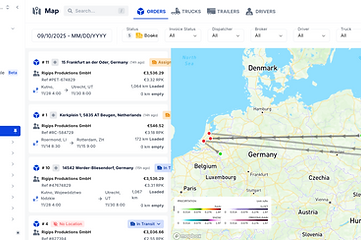
The selected loads are first allocated to Q-TMS users. Thanks to direct visibility into their real-time availability and planning, this can be done completely automatically—reducing planning effort while maximising efficiency.
Step 2: Q-TMS Light
If a load cannot be assigned through Q-TMS, it is offered to Q-TMS Light users. They can simply accept the order through the Q-Platform and incorporate it into their own planning systems.
Step 3: Tendering
If the load remains unassigned, it enters the tender process, where it is offered to a broader group of carriers. The first carrier to accept the offer receives the transport order.
This approach ensures that every load is allocated in the most efficient way possible.
how much....
transport movements materials
construction market/year

Growing Transport Volumes
The number of transport orders managed through our platform will continue to increase as more clients choose to strategically outsource their construction logistics to us.
Our existing clients already represent nearly 20% of the Dutch construction market, and many of them are steadily expanding the scope of logistics activities entrusted to our platform. At the same time, we continue to add new clients to our network.
For 2026, we expect to process more than 100,000 transport orders. Over the coming years, this volume is projected to grow into the tens of millions of transport orders annually.
This is, in fact, a conservative estimate, considering that the construction logistics market in the Netherlands and Germany alone currently accounts for approximately 300 million transport movements each year.
The market is evolving. The real opportunity lies in adapting early and becoming part of that transformation.
There are no longer any compelling reasons not to use Qonnected and the Q-Platform.
like:
no reasons not to
"We are too small."
In our model, the most suitable transport is not determined by company size or fleet scale.
Instead, it is defined by practical availability and fit for purpose.
Key factors include whether a carrier is available at the right time, offers a competitive price, and has the right equipment for the job—for example, a crane truck or other specialised capabilities. Many of these criteria are independent of company size.
In other words, success in allocation is driven by flexibility, capability, and responsiveness, not by how large a transport company is.
"we don’t have electric trucks."
In practice, most transport today is still carried out using diesel vehicles.
At present, the availability of electric trucks is limited, and the existing fleet is not sufficient to handle even a small share of the total demand for transport movements.
In our model, we address this by using a hybrid approach. After cross-docking—often at your delivery location or a nearby hub—we can deploy electric trucks for the final-mile distribution where they are most effective.
In simple terms: full electrification of all transport flows is not yet feasible at scale. That is why we combine existing capacity with electric solutions where they create the most impact, especially in urban and last-mile operations.
"We are fine; we have contracts."
Existing contracts provide short-term certainty, but they do not protect against structural changes in the market.
We operate on behalf of your customers' clients, who are increasingly outsourcing their construction logistics to us. They continue to buy materials from your customers, but they no longer require the transport component to be organised by them.
As this trend accelerates, the logistics volumes managed by your customers will gradually decline, reducing the relevance of traditional transport agreements.
In fact, many of these companies already recognise that outsourcing logistics through our platform delivers measurable savings in both time and cost.
increasing my margin, how does that work?
_edited.png)
Optimising Transport Orders for Maximum Efficiency
Our transport orders are designed to be highly balanced and efficiency-driven. We focus on maximising vehicle utilisation and improving overall transport performance. This includes securing full truck loads (FTL), optimising return freight, reducing empty kilometres, and enabling more FTLs per vehicle per day through smarter routing and planning.
As a transport professional, you will recognise these as the key drivers of strong margins in logistics operations.
At the same time, achieving competitive pricing remains an important part of the equation.
However, even with lower transport prices per individual item, full truck loads continue to deliver stronger overall revenue and better utilisation for carriers.
Finally, when the Q-TMS is used in its full capability—including AI-driven planning—the impact on operational structure is significant.
In many cases, planning departments can be reduced to a fraction of their current size, in some cases from dozens of planners down to just one or two individuals, resulting in substantial cost savings and improved EBIT.
We are aware that AI is disruptive, but this shift is already happening in the market—and competitors will not stand still.
last, but not least
your margin
cost price
transport to wholesaler
wholesalers margin
transport to enduser

cost price
your margin

If you wish to be fully make advantages of everything you can consider using our Q-WMS (Warehouse Management System)
We than fully automate even your warehouse, for optimising all logistics.
And, once optimised, we can also use your warehouse for cross docking.
So we can give you the opportunity to minimise your costs on logistics...
news


